
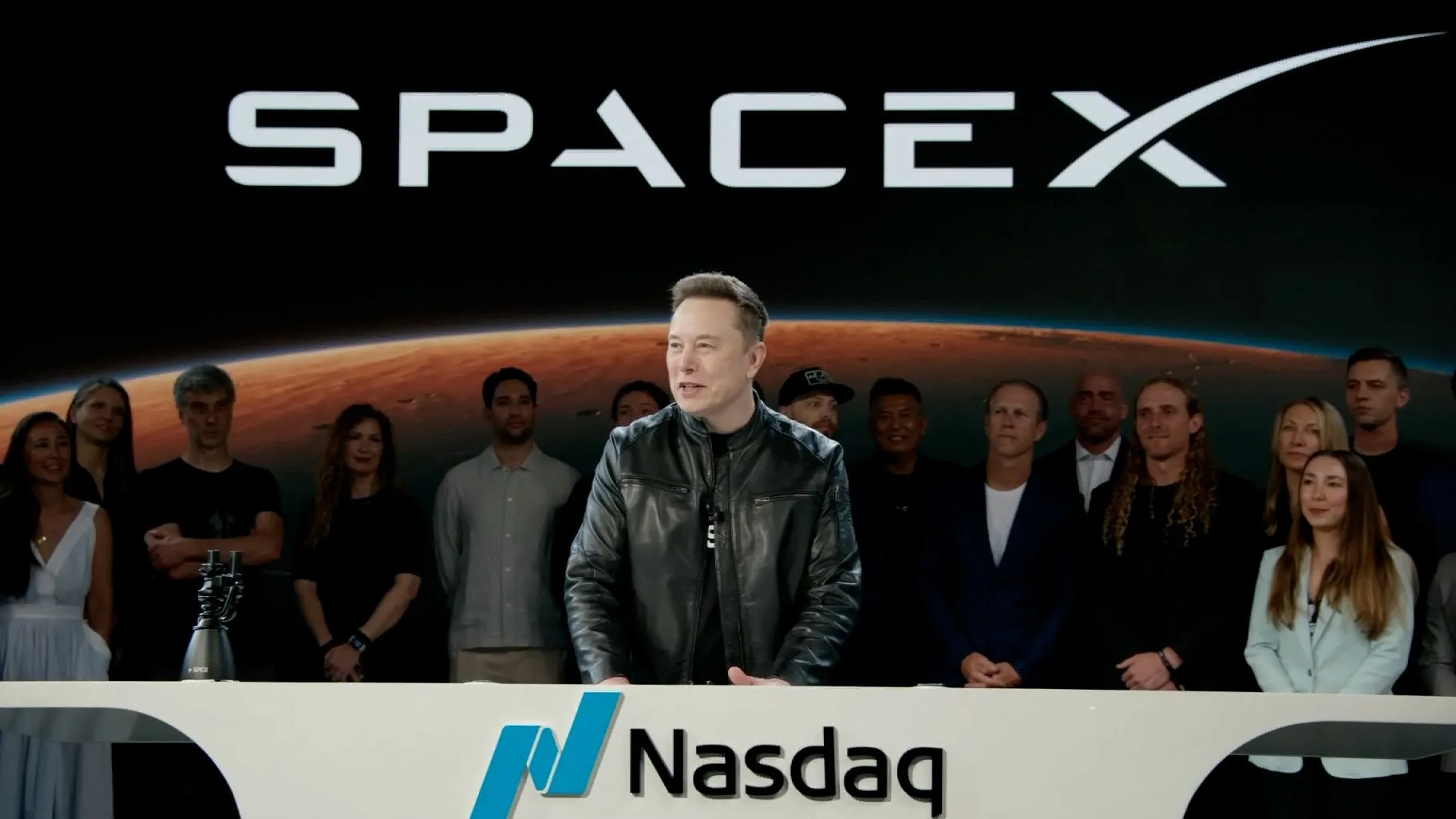
The massive disconnect between legacy corporate valuation models and the raw gravitational pull of the artificial intelligence boom has officially reached escape velocity. In just its fourth day of active public trading following the largest initial public offering in Wall Street history, SpaceX ($SPCX) surged as high as $225.64 on June 16, 2026, pushing its market capitalization to a near-historic peak of $2.85 trillion and briefly breaching the psychological $3 trillion threshold in early trading.
The vertical ascent has instantly rearranged the hierarchy of global capital. By clearing its post-IPO support layers, the aerospace and technology behemoth aggressively vaulted past e-commerce giant Amazon ($2.64 trillion) and briefly wrestled with software pioneer Microsoft ($2.92 trillion) to secure a temporary spot among the four most valuable publicly listed corporations in the United States.
The S-1 Underbelly: Financing the Orbital AI Core
The sheer velocity of the market expansion has caught traditional quantitative analysts off guard, especially given the steep capital expenditure outlines detailed in SpaceX’s official S-1 prospectus. The company reported a substantial $4.94 billion net loss for fiscal year 2025 on $18.67 billion in aggregate revenue.
However, growth-oriented asset managers have completely looked past the short-term red ink, choosing instead to focus on the company’s aggressive, multi-billion-dollar pivot into sovereign AI infrastructure.
The underlying catalyst justifying the multi-trillion-dollar valuation tier is the structural integration of xAI, which SpaceX acquired early this year. The tactical tie-up successfully maps xAI’s land-based Colossus computing clusters and advanced Grok conversational layers directly onto Starlink’s low-Earth orbit satellite network. Underwriter models prepared by Goldman Sachs outline an addressable market reaching into the tens of trillions, anticipating that an orbit-based, sovereign data center grid will completely transform edge computing and global military telemetry by 2030.
Greenshoe Injections and the Impending Passive Index Trap
To support the massive momentum build, underwriters officially disclosed the complete exercise of the IPO’s greenshoe option, instantly scaling total capital raised from the debut to a record-breaking $85.7 billion. Daily turnover metrics verified that over $23 billion in SpaceX stock changed hands in a matter of hours, handily outstripping the combined daily transaction volumes of Nvidia, Apple, and Tesla.
The aggressive price defense is poised to absorb a powerful secondary wave of mechanical capital over the coming fortnights. Because the sheer scale of the listing has triggered “fast-track” inclusion protocols across tier-one benchmark syndicates, passive index-tracking funds linked to the Nasdaq Composite, FTSE, and MSCI matrix are legally required to start accumulating shares to match their underlying weightings. This massive institutional demand layer guarantees near-term liquidity for early retail accumulators, even as value-focused firms like Morningstar warn that companies sitting at the absolute apex of market cap rankings historically face severe headwinds due to size-based overvaluation.
